

We'll cover
ResuScan Vs Jobscan: Which ATS Resume Scanner Is Better in 2026?
Written by Palak Jain
- ResuScan offers more complete feedback including formatting, structure, and ATS compatibility.
- Jobscan is stronger for keyword matching and tailoring resumes to specific job descriptions.
- For beginners or overall resume improvement, ResuScan is easier and more helpful.
- For targeted job applications, Jobscan’s match score and keyword analysis stand out.
- Overall, ResuScan is better for holistic optimization, while Jobscan excels in precision keyword targeting.
We'll cover:
ResuScan vs Jobscan: Which ATS Resume Scanner Is Better in 2026?
Now-a-days, resumes are scanned using software before they ever get seen by a recruiter. This scanning process is called Applicant Tracking Systems (ATS), it utilizes algorithms to filter through your resume to extract relevant keywords, formatting, and content to determine if you are the right fit for the position. As a result of this process, tools like ResuScan and Jobscan have gained popularity with candidates.
Each application will evaluate your resume and provide an evaluation of how well it matches with a company’s job description, as well as suggestions for enhancing the likelihood of passing through an ATS scan.
But in the ResuScan vs Jobscan debate, which tool actually performs better?
To determine this we will review the primary features offered by each service; the level of precision of their reports; comparisons of the price; and how helpful the feedback was provided by each service to come to a conclusion which resume scanning service will be the most beneficial for you when applied to your job search through 2026.
ResuScan and Jobscan both have very useful tools for verifying ATS resumes. Jobscan will have a larger emphasis on keyword matches and job description analysis while ResuScan will provide more general feedback about the entire document (like resume structure & ATS compliance). Jobscan provides a more in-depth keyword optimization tool than does ResuScan; however, ResuScan is an easier place to start for people just getting started with their resume.
What Is an ATS Resume Checker?
An ATS resume checker is software that analyzes a resume to determine how well it matches a job description and whether it can pass Applicant Tracking System filters used by employers.
Applicant tracking systems are often utilized by recruiters to help sift through potential candidates’ resumes before they are reviewed. Various parts of the resume will be scanned by ATS as well as PDF and Word documents. Some examples of what resumes will be screened for by this software include:
- job title
- skills
- experience
- keywords found in the job description
Your resume might never see the light of a human eye to evaluate whether you’re a good candidate for the job, if your resume doesn’t contain the right keywords or its format doesn’t work well with the ATS software. As a result, many people use a resume scanner for their job applications. Software programs, such as ResuScan and Jobscan, enable applicants to identify the missing keywords from their resumes and improve the resume’s format.
What Is Jobscan and How Does It Work?
Jobscan is a Jobscan resume optimizer designed to help job seekers tailor their resumes to specific job descriptions.
To use Jobscan, upload your resume and a job description that you are interested in. Afterward, Jobscan will take both documents and compare them. It will determine what keywords were used in the job description and see if those keywords are present in your resume. Then, Jobscan will provide you with a resume match score that will show how well your resume matches the job description.
In addition to being able to provide a resume keyword scanner for job seekers who are looking to apply for competitive jobs, Jobscan can be used as a professional tool.
Features of Jobscan:
- Advanced Resume Keyword Scanner
- Resume vs Job Description Comparison
- ATS Compatibility Checker
- Resume Match Score
- Optimization of LinkedIn Profile
- Suggestions for Resume Improvement
What Is ResuScan and How Does It Work?
ResuScan is a resume optimization platform that works as an ATS resume checker by analyzing resume structure, formatting, and keyword relevance. ResuScan analyzes your resume and scans it for errors that may cause trouble for the ATS system.
Rather than relying on the conventional method of relying on keywords, ResuScan analyzes various quality factors such as:
- Compatibility of the resume format
- The resume's readability
- The placement of the keywords in the resume
- The overall resume format
Once the resume is scanned, you will receive a resume score as well as tips on how to improve the resume for the ATS program.
Key Features of ResuScan
- A resume checker with an emphasis on ATS programs
- Resume score analysis
- Detection of resume format errors
- Keyword optimization tips
- Tips on how to improve the resume
ResuScan is popular among job seekers looking for a simple resume scanner for job applications that evaluates both formatting and keywords.
ResuScan vs Jobscan – Feature Comparison
In the ResuScan vs Jobscan comparison, Jobscan performs well as a resume keyword scanner, but ResuScan provides more comprehensive resume feedback including formatting and structure analysis.
| Feature | Resuscan | Jobscan |
|---|---|---|
| ATS resume checker | Yes | Yes |
| Resume keyword scanner | Yes | Yes |
| Resume formatting analysis | Strong | Limited |
| Resume structure analysis | Yes | Limited |
| Resume score analyzer | Yes | Yes |
| Ease of use | Very easy | Moderate |
Resume Score Accuracy – Which Tool Is Better?
Both tools offer resume match scores, although they calculate them in different ways.
JobScan primarily uses keyword matching against the job description, which is convenient for matching a resume to an ad.
ResuScan examines multiple criteria, such as formatting, structure, and keyword placement, providing a more realistic view of resume keyword scanner.
Since ATS systems review so many factors, not just keywords, users find that ResuScan’s scores are more helpful for general resume optimization.
Which Resume Scanner Checks Formatting Better?
ATS compatibility is greatly affected by formatting.
Many resumes do not pass an ATS scan due to the following formatting issues:
- Tables
- Graphics
- Non-standard fonts
- Complex layout
ResuScan scans the resumes and looks for these formatting issues before making suggestions for changes. Jobscan primarily focuses on keyword comparison and therefore has a much more limited analysis of formatting.
As a result, ResuScan is a better ATS resume checker in terms of formatting compatibility.
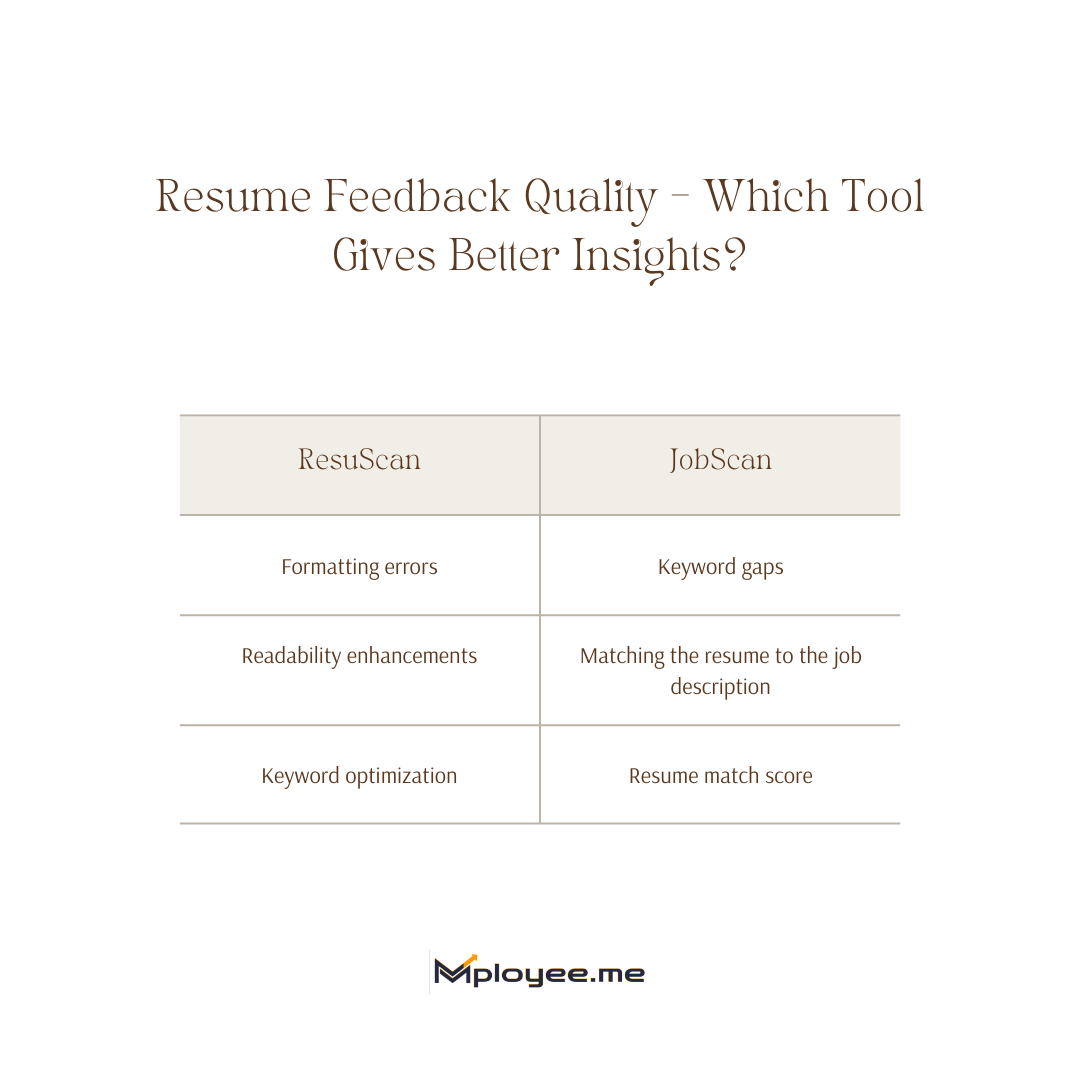
Resume Feedback Quality – Which Tool Gives Better Insights?
When it comes to resume feedback, not all tools are created equal. The depth, accuracy, and relevance of insights can make or break your job application. Here's how Resuscan and Jobscan compare in delivering meaningful, actionable feedback that helps you stand out and land more interviews.
Pricing Comparison: ResuScan vs Jobscan
Jobscan’s pricing is generally higher because of its job description matching features.
ResuScan offers a more affordable option while still providing strong ATS resume checker functionality.
| Plan | Resuscan | Jobscan |
|---|---|---|
| Free version | Gets paid after 10 scan | Limited scan |
| Monthly subscription | Cost is low | Cost is high |
| Premium features | Resume optimization tools | Advanced keyword analysis |
Best Jobscan Alternatives in 2026
If you're exploring alternatives to Jobscan, several platforms provide similar features.
Some of the best resume scanner tools include:
- ResuScan
- ResumeWorded
- SkillSyncer
- Rezi
Among these tools, ResuScan stands out because it combines keyword optimization and ATS compatibility analysis in a single platform without changing platforms.
Who Should Use ResuScan?
Choosing the right ATS resume checking tool can make a big difference in the overall performance of your resume in the job market. Some resume checking tools only look for keywords, but not with ResuScan. They take a more complete look at your resume, checking the format, the overall structure, and the level of importance of the keywords you are using.
Based on the overall performance of the application, ResuScan is best for those individuals looking for a more complete resume checking service than just checking the resume for keywords. It is a good choice for anyone looking for a reliable resume checking application for job seekers, ensuring the resume is optimized for Applicant Tracking Systems before it is even submitted to an employer. For increased impact, you may want to consider using a tool like Flipsnack to make your resume more interactive and easier to share.
ResuScan is ideal for job seekers who:
- Want a reliable ATS resume checker
- Need help fixing resume formatting issues
- Want overall resume feedback
- Want a simple resume scanner for job applications
Students, graduates, and professionals switching careers often benefit most from ResuScan.
Final Verdict – ResuScan vs Jobscan
Jobscan and ResuScan are both great choices when it comes to using an ATS-compliant resume. ResuScan provides a more complete solution to job seekers by not only identifying differences in formatting, structure, and keyword use, but also by providing all of this information in one analysis. For the majority of people's needs from a full ATS resume check tool, ResuScan's balanced approach will yield better results.
However, when looking for a match between your resume and job description, Jobscan (as a resume keyword scanner) can certainly help.
Is ResuScan better than Jobscan for ATS resume optimization?
When you compare ResuScan and Jobscan, it’s easy to see that they are addressing two very different problems. Jobscan is clearly designed to be a resume keyword search tool, intended to scan a resume against a given job description. ResuScan, meanwhile, appears to be designed to be a resume ATS check tool, intended to improve the overall compatibility of a resume with applicant tracking systems.
Can resume scanner tools really improve job application success?
What makes ResuScan different from other resume scanner tools?
How can I improve my resume ATS score?
Is a resume keyword scanner necessary for job seekers?

Got Your Answer ?

Career Blogs
Our career blog is your go-to resource for insightful advice, practical tips, and the latest trends in the job market.







Office Address: Room No 305, IIT ROPAR-TBIF, Top Floor (East Wing), M.Visvesvaraya, Rupnagar PB, 140001
- Free Online Resume Review
- Check Resume Score
- Job Description Keyword Finder
- Resume Shortlisting Software
- Resume Scanner for Jobs
- Find jobs that match with resume
- Job matching platform
- Resume job matching
- Job suggestion
- Best sites to find jobs
- Free ats resume scanner
- Auto apply for job
- Full Time Jobs
- I Need a Job
- Information Technology Jobs
Can't Find Something? Get in Touch.
©2026 Padhakku Peek A Book Pvt Ltd (Mployee.me)


